

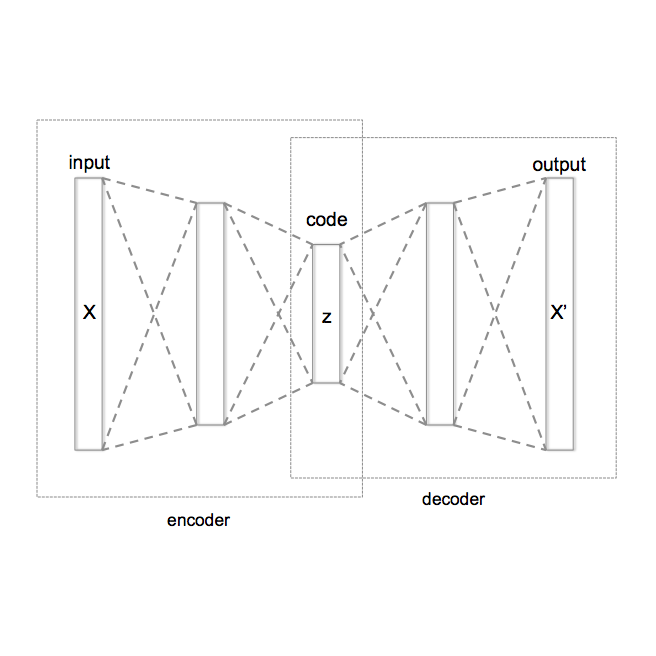
Many properties of perceptual decision making are well-modeled by deep neural networks. However, such architectures typically treat decisions as instantaneous readouts, overlooking the temporal dynamics of the decision process. We present an image-computable model of perceptual decision making in which choices and response times arise from efficient sensory encoding and Bayesian decoding of neural spiking activity. We use a Poisson variational autoencoder to learn unsupervised representations of visual stimuli in a population of rate-coded neurons, modeled as independent homogeneous Poisson processes. A task-optimized decoder then continually infers an approximate posterior over actions conditioned on incoming spiking activity. Combining these components with an entropy-based stopping rule yields a principled and image-computable model of perceptual decisions capable of generating trial-by-trial patterns of choices and response times. Applied to MNIST digit classification, the model reproduces key empirical signatures of perceptual decision making, including stochastic variability, right-skewed response time distributions, logarithmic scaling of response times with the number of alternatives (Hick's law), and speed-accuracy trade-offs.
翻译:感知决策的许多特性可通过深度神经网络进行有效建模。然而,此类架构通常将决策视为瞬时读出过程,忽略了决策过程中的时间动态特性。本文提出了一种可图像计算的感知决策模型,其中选择行为与反应时间源于对神经脉冲活动的高效感觉编码与贝叶斯解码过程。我们采用泊松变分自编码器,在由独立齐次泊松过程建模的速率编码神经元群体中,以无监督方式学习视觉刺激的表征。随后通过任务优化的解码器,持续基于传入的脉冲活动推断动作的近似后验分布。将上述组件与基于熵的停止规则相结合,构建出能够逐试次生成选择模式与反应时间的、具有理论依据且可图像计算的感知决策模型。在MNIST手写数字分类任务中,该模型成功复现了感知决策的关键经验特征,包括随机变异性、右偏态反应时间分布、反应时间随备选数量增加的对数尺度变化(希克定律),以及速度-准确率权衡现象。




相关内容


 微信扫码咨询专知VIP会员