

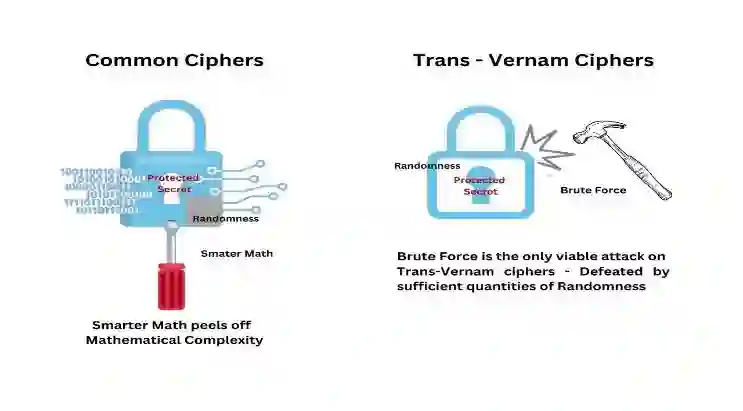
Artificial Intelligence (AI) presents prodigious technological prospects for development, however, all that glitters is not gold! The cyber-world faces the worst nightmare with the advent of AI and quantum computers. Together with Quantum Artificial Intelligence (QAI), they pose a catastrophic threat to modern cryptography. It would also increase the capability of cryptanalysts manifold, with its built-in persistent and extensive predictive intelligence. This prediction ability incapacitates the constrained message space in device cryptography. With the comparison of these assumptions and the intercepted ciphertext, the code-cracking process will considerably accelerate. Before the vigorous and robust developments in AI, we have never faced and never had to prepare for such a plaintext-originating attack. The supremacy of AI can be challenged by creating ciphertexts that would give the AI attacker erroneous responses stymied by randomness and misdirect them. AI threat is deterred by deviating from the conventional use of small, known-size keys and pattern-loaded ciphers. The strategy is vested in implementing larger secret size keys, supplemented by ad-hoc unilateral randomness of unbound limitations and a pattern-devoid technique. The very large key size can be handled with low processing and computational burden to achieve desired unicity distances. The strategy against AI odds is feasible by implementing non-algorithmic randomness, large and inexpensive memory chips, and wide-area communication networks. The strength of AI, i.e., randomness and pattern detection can be used to generate highly optimized ciphers and algorithms. These pattern-devoid, randomness-rich ciphers also provide a timely and plausible solution for NIST's proactive approach toward the quantum challenge.
翻译:暂无翻译




相关内容




 微信扫码咨询专知VIP会员