

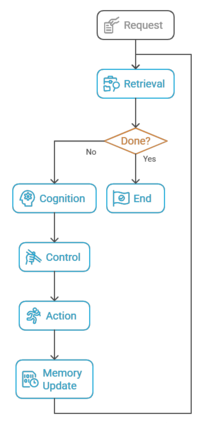
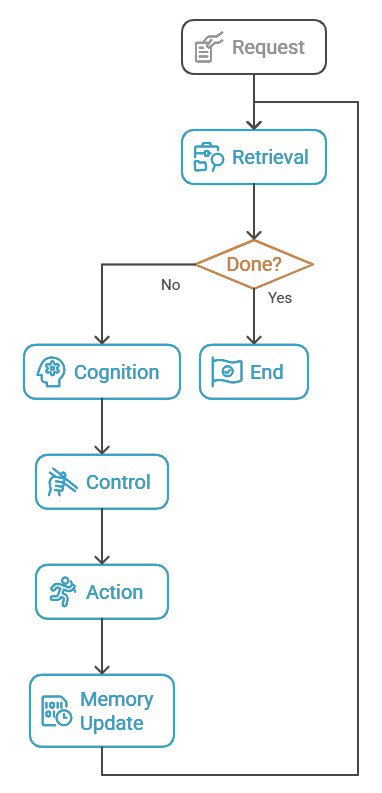
We report a structural convergence among four influential theories of mind: Kahneman's dual-system theory, Friston's predictive processing, Minsky's society of mind, and Clark's extended mind, emerging unintentionally within a practical AI architecture known as Agentic Flow. Designed to address the limitations of large language models (LLMs), Agentic Flow comprises five interlocking modules: Retrieval, Cognition, Control, Memory, and Action, organized into a repeatable cognitive loop. Although originally inspired only by Minsky and Clark, subsequent analysis revealed that its structure echoes computational motifs from all four theories, suggesting that theoretical convergence can emerge naturally from implementation demands rather than deliberate synthesis. Controlled evaluations confirmed this: the structured agent achieved 95.8% task success versus 62.3% for baseline LLMs, demonstrating robust constraint adherence and reproducible reasoning. We describe this convergence under a broader descriptive meta-architecture called PEACE, highlighting recurring design patterns such as predictive modeling, associative recall, and error-sensitive control. Later formalized as the Structured Cognitive Loop (SCL), this framework generalizes the same principles as a foundation for behavioral intelligence in LLM-based agents. Rather than claiming theoretical unification, this paper proposes that intelligent architectures may evolve toward shared structural patterns shaped by practical constraints. As a position paper, it aims to frame this convergence as an interpretive reflection rather than a finalized theory, inviting further theoretical and experimental dialogue. Agentic Flow, or equivalently the Structured Cognitive Loop, thus offers a glimpse of how a unified cognitive form can arise not from abstraction, but from the necessities of real-world reasoning.
翻译:暂无翻译





相关内容





 微信扫码咨询专知VIP会员